Anyone who has ever watched a crowd of two hundred executives slowly wilt in an unshaded courtyard—or stand in a twenty-minute queue outside a single overwhelmed restroom—knows a hard truth about corporate hospitality. Guests rarely remember the exact shade of linen on the cocktail tables, and they certainly won’t praise your centerpiece arrangements on Monday morning. What they do remember, viscerally, is friction. When a business hosts a product launch, summer company picnic, or outdoor networking mixer, every logistical oversight reflects directly on the brand’s competence. Great event planning isn’t about dazzle; it is about quietly eliminating bottlenecks before attendees ever realize they exist.
Lock in Your Objectives and Realistic Budget Buffers
Before signing a venue contract or browsing catering menus, anchor the entire event to a single primary objective. Too many corporate gatherings fail because stakeholders try to cram lead generation, employee appreciation, and press outreach into the same three-hour window, resulting in a muddled schedule that satisfies no one. Decide early whether the gathering exists to close pipeline deals or reward internal teams, then filter every spending decision through that lens.
Once your goal is set, build your financial plan backward from non-negotiable infrastructure:
- Secure your anchor dates and permits first. Municipal permits for outdoor spaces, tenting, and amplified sound often require sixty to ninety days of lead time, making them your true starting line.
- Ring-fence a 15 to 20 percent contingency buffer. Treat this money as untouchable until event week, reserving it strictly for weather pivots, emergency generator rentals, or last-minute headcount spikes.
- Lock in core logistics before decor. Allocate funds to shelter, power, and sanitation prior to finalizing floral budgets or branded swag bags.
Audit Site Infrastructure and Guest Comfort Early
A venue walkthrough conducted at ten in the morning tells you almost nothing about how that same space will behave at four in the afternoon. Whenever possible, visit your site at the exact hour your event will take place. Pay close attention to where the sun sits, how wind tunnels between buildings, where cellular signals drop, and where natural foot traffic bottlenecks around bars or buffet lines.
Overlooking basic human comfort is the fastest way to empty an outdoor venue early. Permanent building restrooms are rarely built to handle sudden surges of hundreds of guests drinking coffee or cocktails, and long queues immediately stall networking momentum. Partnering early with a dependable porta potty rental company solves this problem before it starts, giving you accurate unit-to-guest ratios, ADA-compliant access, and upscale restroom trailers that feel clean and intentional rather than like an afterthought. While reviewing the site map, trace the exact paths delivery trucks and guests with mobility devices will take so nobody is forced to navigate steep curbs, tangled cables, or soft turf.
Build Redundancy Into Your Vendor and Tech Stack
Picture the moment a keynote speaker steps up to the podium, clicks the remote, and nothing happens—while the check-in tablets at the front gate simultaneously freeze because the venue’s guest Wi-Fi just buckled under two hundred smartphones. Single points of failure turn minor technical hiccups into full-blown operational emergencies.
The antidote is deliberate redundancy paired with ruthless vendor alignment. Seventy-two hours before load-in, distribute a master Run of Show that locks in staggered arrival windows, parking zones, and on-site emergency contacts for every supplier—from catering and audiovisual technicians to security and sanitation crews. Ask your AV lead to bring dedicated cellular hotspots rather than relying on house internet, confirm that backup generators are fueled and tested for critical lighting and sound, and always print alphabetical paper check-in rosters. It takes five minutes at an office printer and saves an entire registration line when cloud software inevitably stalls.
Design High-Engagement Touchpoints and Post-Event Follow-Up
Even well-fed, comfortable guests will drift toward the exits if an event feels like a passive obligation. Instead of scattering high-top tables across an open lawn and hoping strangers strike up conversations, build natural gravitational pulls into the floor plan—a live product sandbox, a short fireside Q&A, or a curated lounge area that encourages people to linger.
Just as importantly, treat the end of the event as the midpoint of your campaign. Draft your post-event follow-up emails and brief feedback surveys a full week before the doors open, when your team isn’t exhausted from teardown. Automating those messages to deploy within twenty-four hours captures attendee enthusiasm while conversations are still fresh, turning a pleasant afternoon into measurable business momentum.
Bring Invisible Logistics to the Forefront
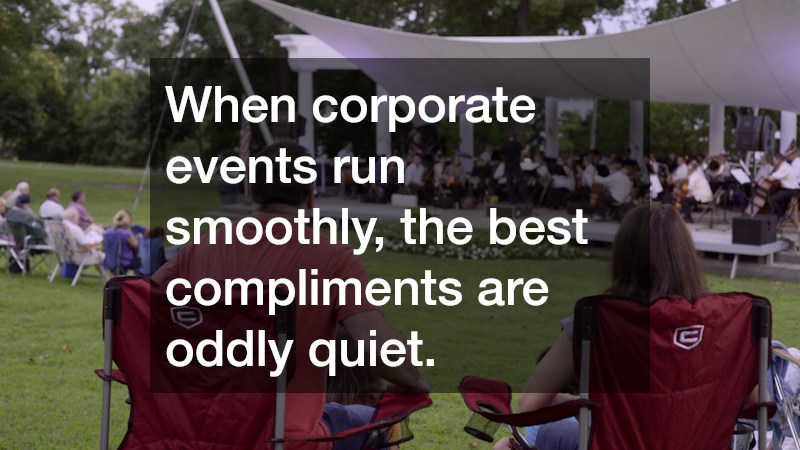
When corporate events run smoothly, the best compliments are oddly quiet. Nobody pulls an organizer aside to applaud adequate amperage, clear signage, or well-placed restrooms—they simply stay longer, talk more freely, and leave with a sharper impression of the company hosting them. By prioritizing site realities, vendor redundancy, and thoughtful pacing from day one, you free your team to step out of troubleshooting mode and actually connect with the people in the room.